What to Wear When You Go Straight From the Studio to Dinner

Quick Answer: Dinner needs two swaps, not one, and one of them has to change the fabric story. Swap the bottom or add a structured layer that changes the outfit’s material register, then swap the shoe. Keeping the same activewear bottom and just adding a jacket reads as gym clothes at a table, because the fabric sheen and the seams are still doing the talking. The other half of it is practical: you need a plan for cooling down and for hair, and both need to happen before you leave the studio.
The one-swap formula works for a coffee, a shop and a school pickup. It does not survive a restaurant.
This blog has covered the one-swap formula, why it breaks in cold weather, and why your outfit still looks like gym clothes. Dinner is where the formula’s limit becomes obvious.

Why does one swap stop working for dinner?
Because a restaurant is a seated, lit, close-quarters environment and the signals that pass at a distance do not pass at a table.
Fabric reads differently up close. Technical fabric sheen, mesh panels and bonded seams are invisible from across a street and obvious across a table.
Seated, the bottom half is at eye level for everyone opposite you, which is exactly the half a jacket does not cover.
Restaurant lighting is warm and directional, which highlights sheen far more than daylight does.
You are stationary for two hours, so nothing is masked by movement, and any damp fabric stays damp.
And the social register is different. Errands and coffee tolerate athletic clothing entirely; a dinner where everyone else has changed puts you in a different category, whether or not anyone comments.
Which means the swap has to change the material story, not just add a layer over it.
What are the two swaps that actually work?
One that changes fabric, one that changes formality — in that order of importance.
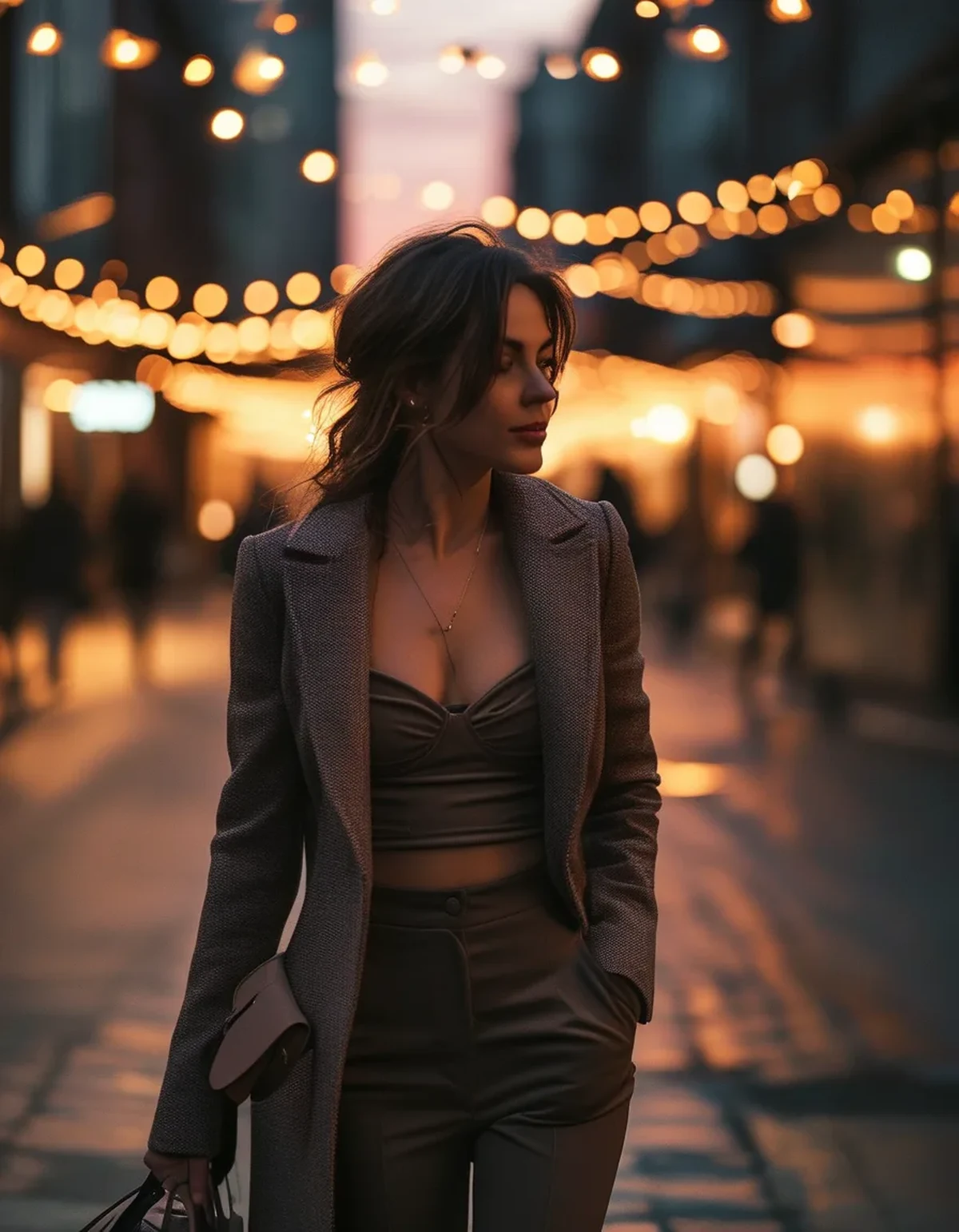
Swap one: the bottom, or a layer that changes the fabric register. A knit trouser, a midi skirt, or a wide-leg trouser rolled in your bag takes thirty seconds and does more than everything else combined. If you keep the legging, the top layer must be a genuinely different material — wool, denim, leather, a structured blazer — not another technical fabric.
Swap two: the shoe. A loafer, an ankle boot or a flat mule. A trainer with an otherwise dressed outfit is a deliberate look when everything else is tailored, and simply reads as gym kit when it is not.
A third if you have room: the top. A fine knit or a silk-feel top over a sports bra is light, packs to nothing, and removes the last athletic signal.
Prioritise the bottom if you can only do one. The bottom half is what a seated dinner shows.
And choose one hard accessory — a real bag rather than a gym bag, a watch, earrings. One structured item shifts the whole read.
Keep everything in a single small bag. Two bags at a restaurant defeats the point entirely and is the most common failure of the whole exercise.
What Nobody Tells You About the Practical Half
The clothing is the easy part. Cooling down and hair are what actually determine whether this works.
Stop sweating before you change. Putting a fresh layer on a hot body means you are damp again within ten minutes. Give it ten minutes and a cool rinse if the studio has one.
Change your base layer, always. A sports bra worn through a class and then through dinner is uncomfortable, cold, and the source of most post-workout dinner misery.
Deodorant, a facial wipe and dry shampoo weigh nothing and cover the vast majority of what a shower would do.
Have a hair plan decided in advance. Down over a sweaty scalp rarely works; a deliberate low bun, a slicked-back style or a claw clip does, and choosing it in the changing room at speed does not.
Bring a warm layer for after. You lose heat quickly after exercise stops, and being cold at dinner is the most common complaint about doing this at all.
Pack the night before. A studio-to-dinner outfit assembled in a rush in the morning is the one that ends up as leggings and a jacket.
And roll rather than fold. A knit trouser rolled in a small bag comes out fine; folded, it comes out creased in exactly the wrong places.
What if you genuinely cannot change the bottom?
Then everything above and below has to work harder, and it can be made to work.
Choose a matte, seamless, full-length legging in black. No sheen, no visible panelling, no contrast stitching, full length so there is no athletic ankle detail.
Go long and structured on top. A longline blazer, a wool coat, or a long knit that covers the seat changes the proportion enough that the legging reads as a base layer rather than as the outfit.
Make the shoe unambiguous. A boot or loafer here, never a trainer — with a legging, the shoe is carrying the entire signal.
Add texture deliberately. Wool, leather, denim, suede — one substantial natural-material item breaks the all-technical fabric read more effectively than anything else.
Avoid the matching set. A matched activewear top and bottom under a jacket reads as sportswear no matter what the jacket is.
And check it seated in a mirror before you go. The standing check misses the whole problem, because the standing check is not the condition you will be in.
FAQ: Studio to Dinner Questions, Answered
Can you wear leggings to dinner?
Yes, if the rest of the outfit does the work: a matte seamless full-length legging, a long structured layer in a natural material such as wool or leather, and a loafer or boot rather than a trainer. What fails is a legging with visible athletic panelling under another technical layer.
What should I pack for a studio-to-dinner change?
A knit trouser or midi skirt rolled small, a fresh base layer, a fine knit top, a non-trainer shoe, and a small structured bag. Add deodorant, a facial wipe and dry shampoo. Everything in one bag — arriving with a gym bag undoes the whole thing.
How do I stop sweating after a class before going out?
Give yourself ten minutes before changing, rinse your face and neck in cool water, and change your base layer completely. Putting fresh clothes onto a hot body is the reason people feel damp again ten minutes later.
TL;DR:
- Dinner needs two swaps: one that changes the fabric register, one that changes the shoe. One swap is an errands formula.
- Seated at a table, the bottom half is at eye level and technical fabric sheen is obvious under warm restaurant lighting.
- Change your base layer and cool down for ten minutes before changing, or you will be damp again immediately.
- If the legging has to stay: matte, seamless, full-length, under something long in wool or leather, with a boot or loafer.
Pack the night before and use one bag. Arriving with a gym holdall undoes every other decision you made.
See It in Motion
Seen here: Racerback Tank Top - White — shop similar styles on bubblelime.com
Keep Reading
This article is for general informational and styling purposes only. Fit, sizing, and product availability may vary.