Why the Studio to Street Outfit Breaks Down at the Coffee Stop

Quick Answer: Sitting still after exercise is the moment your body switches from producing heat to losing it rapidly, while your clothes are still damp. Damp fabric conducts heat away far faster than dry fabric, so you get cold in a room that feels perfectly warm to everyone else. The fix is a dry base layer swap plus one insulating layer you put on before you sit down, not after you feel cold.
The outfit worked in class.
It worked on the walk.
Then you sat down with a coffee and within ten minutes you were quietly freezing while everyone else was fine.

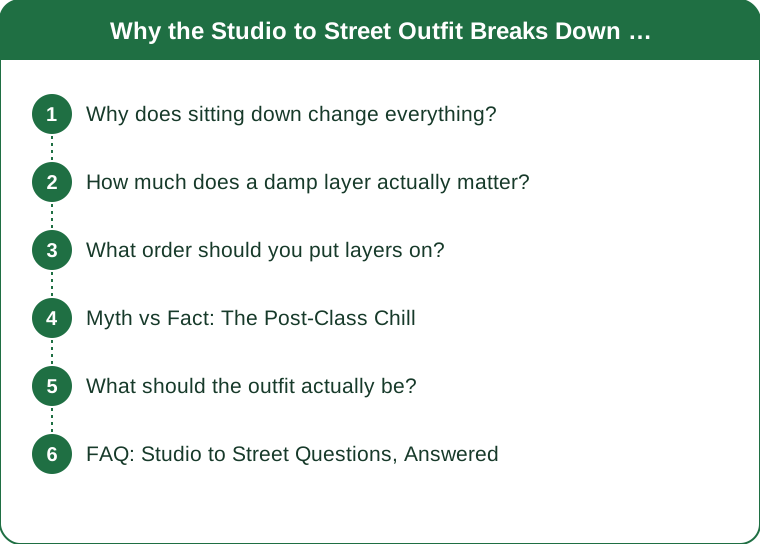
Why does sitting down change everything?
Because your heat production drops off a cliff while your heat loss does not.
During a class, working muscle produces a large amount of heat, and your body compensates by dilating skin blood vessels and sweating. When you stop, muscle heat production falls within minutes, but skin blood flow stays elevated for a while and you are still carrying sweat.
Then you sit still. Movement was generating a small amount of warmth and, more importantly, keeping a layer of warm air moving around you. Sitting removes both.
The result is a genuine mismatch. The cafe is at a normal indoor temperature and you are cooling faster than the room can warm you. It is not that you are unusually cold-natured. It is that you arrived in a different thermal state than everyone else in the room.
How much does a damp layer actually matter?
It is the single biggest variable, and it is the one most people ignore.
Water conducts heat away from the body far more effectively than air does — by a large multiple. A damp base layer against your skin is essentially a cooling system that you have no way to switch off, and it keeps working as long as it stays damp.
This is why a fresh dry t-shirt makes a bigger difference than a heavier jumper over a damp one. The jumper insulates the outside; the damp layer keeps stripping heat from the inside.
The practical version: carry one dry base layer, always. A thin long-sleeve or a t-shirt in a rolled bundle takes almost no bag space, and swapping it in the changing room before you leave changes the entire next hour. If a full change is not possible, at minimum swap the layer directly against your torso.
What order should you put layers on?
Before you cool down, not after — and this is the part that is genuinely counterintuitive.
Most people wait until they feel cold to add a layer. By then you have already lost a meaningful amount of heat and the layer is insulating a body that is now under-warm. Insulation does not add heat; it slows loss. Adding it late means you stay slightly cold for the rest of the outing.
The better sequence:
In the changing room: swap the damp base layer for a dry one while you are still warm.
Before you leave the building: add your mid layer, even if you feel too warm for it. That slight over-warm feeling is exactly right, because you are about to lose heat.
On sitting down: keep the outer layer on for the first ten minutes rather than draping it over the chair. If you are still warm after ten minutes, take it off then.
It is a small reordering and it removes most of the problem.

Myth vs Fact: The Post-Class Chill
Myth: You need warmer clothes for the walk home. Fact: You need drier clothes. Warmth over damp is far less effective than dryness under something moderate.
Myth: If you are not shivering, you are fine. Fact: Shivering is a late signal. The earlier signs are cold hands, a stiff neck and a general reluctance to stay out, which most people attribute to tiredness rather than temperature.
Myth: Cotton is fine for a post-workout layer. Fact: Cotton holds a great deal of moisture and dries slowly, which makes it a poor choice for the layer against your skin. It is an excellent outer or mid layer — a cotton sweatshirt over a dry technical base is a genuinely good combination.
Myth: The chill is just about the temperature outdoors. Fact: Air-conditioned cafes in late summer are one of the worst environments for this, because the outdoor warmth means you did not bring a layer and the indoor cooling does the rest.
Myth: A hot drink solves it. Fact: It genuinely helps how you feel and does very little for your actual heat balance. Enjoy the coffee, but bring the layer too.
What should the outfit actually be?
Think of it as three decisions rather than an outfit.
The layer against your skin should be technical, thin, and replaceable. A merino or synthetic long-sleeve is ideal, because both handle moisture far better than cotton. This is the layer you swap.
The mid layer is where you get to have taste. An oversized knit, a cotton sweatshirt, a soft overshirt, a lightweight quarter-zip — anything with enough volume to trap air. This is also the piece that makes the outfit read as intentional rather than as gym clothes, so it is worth owning one that you genuinely like.
The bottom half matters less than people assume, because your legs cool more slowly and are usually less sweaty than your torso. Leggings are fine. What helps is something over the top — a short wrap skirt, a longline layer, or wide trousers pulled on — which adds a little insulation and shifts the whole look toward street.
Seasonally, this is the point in late August when this stops being optional. Evenings are cooling before daytimes are, so the class that was fine in a vest at 7pm three weeks ago now needs the mid layer on the way home.
FAQ: Studio to Street Questions, Answered
What if I do not have time to change?
Swap only the top layer against your skin and add your mid layer immediately. Even a thirty-second change makes a bigger difference than any amount of extra insulation over damp fabric.
Is merino worth it for this?
For the base layer specifically, yes. Merino holds warmth reasonably well even when slightly damp and resists odour, which is exactly the combination you want in a layer that lives in your bag.
Why do I only get cold after certain classes?
Sweat volume. A hot yoga or high-intensity class leaves you far damper than a slow strength session, so the same outfit behaves completely differently. Match the change of clothes to the sweat, not to the schedule.
TL;DR:
- Sitting still after class drops heat production while a damp base layer keeps pulling heat away from your skin.
- The dry layer matters more than the warm layer — swap the base, then add the mid layer.
- Add insulation before you feel cold, not after, because layers slow heat loss rather than adding heat.
- Air-conditioned cafes in late summer are the classic trap, because nobody packs a layer on a warm day.
It was never a styling failure. It was a heat-transfer problem wearing a very nice jumper.
Keep Reading
This article is for general informational and styling purposes only. Fit, sizing, and product availability may vary.